


AI changed how one creates content; text Generators, summarization and idea Generators or even quick Writings. With that Said, The AI’s Content tends to be very generic, generic and too formal. This is why humanize the AI has become so Popular and Relevant for Today’s reader and thought creator.
What Does Humanize AI Mean?
What is humanize AI in general: The humanize AI is meant to rewrite AI-written texts in a way they will seem human and sound completely naturally written. In this context, instead of directly sharing an AI-written draft, a human writer needs to ensure the text becomes more readable to readers. The primary aim here, it is quite obvious to make the content sound less artificial, robot-like, etc.
Why Does AI Content Sometimes Sound Artificial?
The capabilities of AI technology lie in how it can find these patterns in text-based data sets to create writing which tends to conform to certain patterns and often contains repetitive wordings/phrases which sound similar to each other.
AI Articles often contain the use of too many transition words, pointless headings, explanations are repeated, statements are very generic and therefore the AI Article sounds a little bland even though it could potentially include a lot of factual content, however these humanise AI techniques can be used to iron these patterns out, incorporate more human-like language, concrete examples, different wording and increase reader interest levels.
Making Writing More Conversational
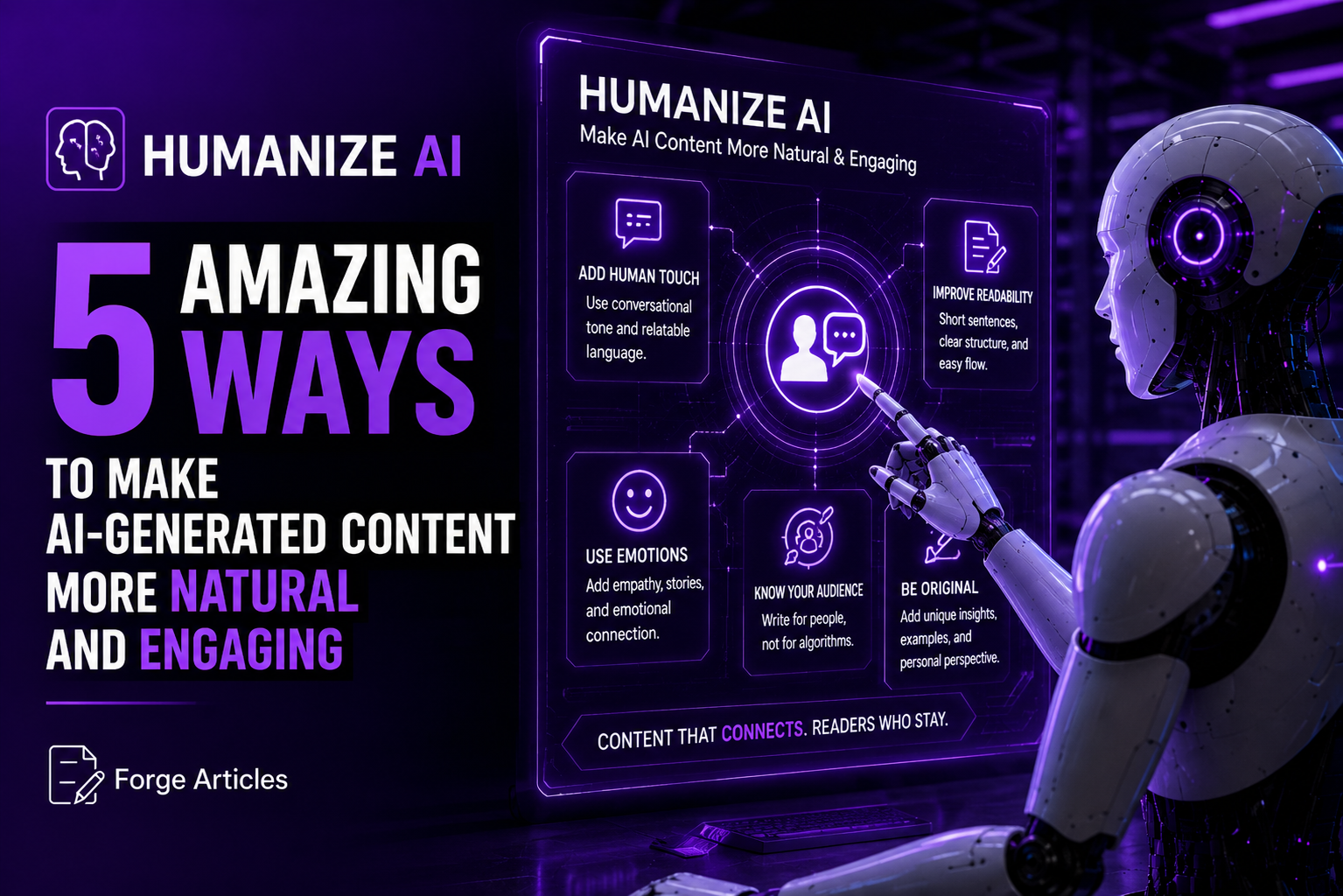
One very convenient way of how to humanize AI text would be naturalize the wording wherever possible You do not need complex words and phrasings but words a normal human would say “normally”. Longer and shorter sentences to play a rhythm. Humanization would try to make the AI text easier for a human reading, but not less readable and unnecessarily sophisticated to appear a real human.
Adding Personal Perspective and Examples
When writing generally, it’s easy for the article to seem like it was written by artificial intelligence. Adding details, like specific examples, observations, a personal experience, or targeting specific needs of the reader can make writing far more useful.
For example, if the author is providing information on how an individual can use artificial intelligence to be more productive, the author can talk about how a business owner might leverage the technology to brainstorm new ideas for social media posts, or structure a repetitive process that will keep an article interesting.
This strategy helps add a human dimension to the author’s motivation to not simply change words and the way they are arranged into sentences; it offers specific details that are pertinent to what the reader and the author set out to accomplish.
Improving Structure and Flow
AI created articles are usually all the same. Perhaps, you will feel like all the chapters have the same tone, or length, or are structured in almost the same way. When utilizing the humanize AI writing assistance, human writers can evaluate the whole chapter not just separate sentences.
Maybe, there is a need to couple some chapters up and delete some.
Furthermore, the organization of ideas is vital, so the information pieces should not just be randomly inserted but logically. These actions make the document more approachable and avoid it being mechanically and formulaic in tone.
Avoiding Overused AI Language
We overuse certain words in AI-generated material. A phrase like ‘in today’s fast-paced, ever-changing world’, ‘please note’ or whether ‘whether you’re a rookie or seasoned veteran’ often appears multiple times in the same AI article.
Replacing clichés with better alternativesOne method to humanize ai our copy is to switch up these generic sentences for something that’s more contextually relevant. We need to keep it human and avoid it sounding anything but natural.
Human Review Still Matters
Although AI can be used to assist with the drafting process, it is a human that needs to perform all of the actions needed to get to a trustworthy result. A producer will need to notice falsehoods that the AI had not picked up on, add context required, correct grammar errors, take down unverified facts andremove anything that might be seen as offensive, to an extent that could still mean that what is written is suitable for the end reader.
Therefore, articles that were written with the assistance of humanize AI which were later edited by humans can be referred to as a collaboration of artificial intelligence and humans. In addition to this, any facts provided within the finished article need to be double-checked, and then ensure that the content works for the specific publication it is intended for.
Humanize AI and Content Quality
Humanising a piece shouldn’t look like masquerading AI writing as human writing It would better to think of them more as, creating a piece of writing which actually offers value to the person consuming it.
Value to a reader coming down to things like how the material inside a post answers questions, whether there is any good data provided in the content, whether there is useful material included such as example data and whether it is comprehensible. In these areas the role of humanising AI can take effect instead.
Final Thoughts
AI is an assistant, but not an editor: it simply doesn’t possess judgment. An AI won’t inherently understand what information to remove, include relevant examples of, or that is particularly crucial given its intended audience. Humanize ai your AI writing processes to take an otherwise mundane draft and create an easy to understand, valuable, and clear piece of writing, and to maintain a distinctly human element in AI-written pieces.
Making changes to sentence structures, removing filler language, addingrelevantem exemplars, altering structure, editing, and proofing-doing any of these can have the result you want.
The central premise of humanize ai your AI practices or processes is all about getting better. Remember not to simply use AI without scrutiny or the need for refinement-take advantage of its awesome powers, but use them to improve your own writing and to serve your reader better.
