


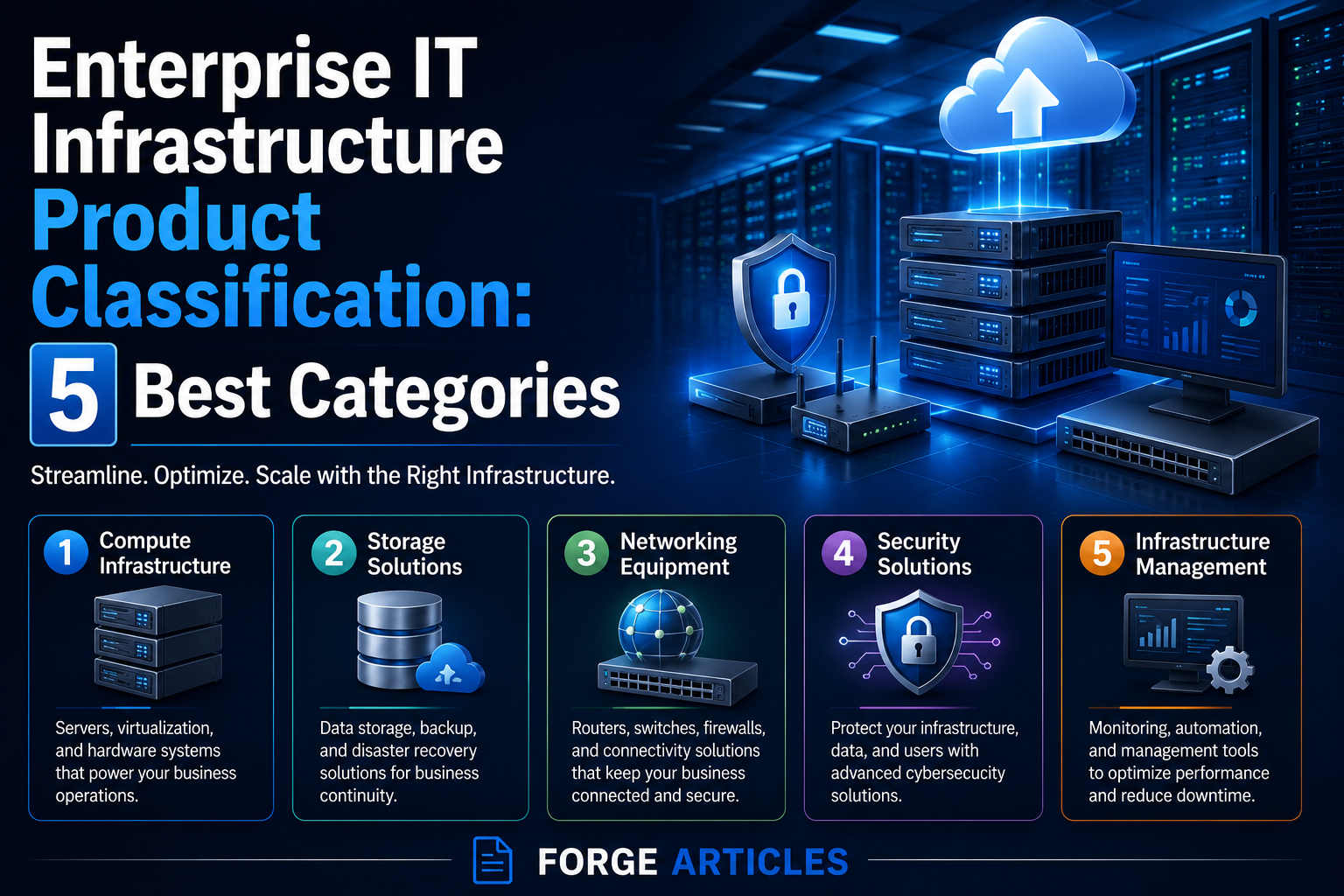
An organized enterprise IT infrastructure product classification framework is essential in today’s complex digital environment. Regardless of whether the enterprise is a global multinational business, a fast-growing finance provider, a public sector government organization, or a cloud services company, the organization owns and operates enormous, fragmented technological landscapes.
While the hardware and software in smaller businesses may only be a simple, spontaneous IT setup, an enterprise can’t organize and categorize what it owns.
Formal product categorization is therefore an essential business prerequisite to provide optimum levels of efficient operationality, data integrity, and budget-friendly procurement.
Defining Enterprise IT Infrastructure Product Classification
The enterprise IT infrastructure product classification system is the structured process to classify, inventory, and manage all the software and hardware elements that make up the digital structure of an enterprise. This system provides not just a system of accounting.
It will provide relationships across hardware, operational dependencies, and the lifecycle of the costs of all hardware.
By placing products in categories that make sense for everyone in enterprise architecture and the procurement process, you can prevent having overlapping hardware and patch all product family systems with a single system security patch.
Core Pillars of Enterprise Product Classification
A sturdy classification blueprint of today categorises assets within its structure in its corporate infrastructure, using four base domains as a cohesive plan to manage risks:
1. Compute and Processing Frameworks
This group comprises the main building blocks for the company’s fundamental processing infrastructure. It can range from high-density rack servers and blade server enclosures to Hyperconverged enterprise it infrastructure product classification (HCI) devices and enterprise virtualisation layers, enabling one physical box to run hundreds of segregated, isolated virtual environments.
2. High-Performance Storage Solutions
At the core of a modern enterprise are business applications that depend on specific storage systems. The purpose of this category is to differentiate enterprise-class Storage Area Networks (SANs), Network Attached Storage (NAS), enterprise all-flash storage, and hardened cloud storage gateways that manage petabytes of mission-critical operating data while being absolutely fault-tolerant.
3. Enterprise Networking Systems
Moving information seamlessly needs a strong but agile core of switches and routers. This category of solutions includes deep packet core switches, perimeter firewalls, software-defined WAN (SD-WAN) devices, load balancers, and physical fibre-based distribution systems linking up offices globally.
4. Data Center Physical Facilities
Virtualization relies on a strong base of security-focused hardware to succeed. This cluster monitors the industrial UPS, the commercial data center cooling infrastructure, environment monitoring devices, security devices for your physical assets, and any automatic diesel backup systems you may have for your infrastructure.
Why Ad-Hoc IT Management is Insufficient
Numerous startups are caught using unclassified, chaotic procurement spreadsheets for their hardware assets. Sure, you might record purchase dates in a spreadsheet, but you entirely fail to capture the hundreds of thousands, if not millions of dollars, you’re bleeding by not documenting the hardware lifecycle, leaving stray cloud instances, or supporting a slew of software versions.
In addition, generic, unstructured asset tracking doesn’t provide the technical precision to accurately pass a global regulatory audit. Proper enterprise IT infrastructure product classification has a defined taxonomy and structure so every hardware, cloud, and software asset can be easily found, 100% compliant, and readily visible to security for emergency patch cycles.
5 Best Benefits of Enterprise IT Infrastructure Product Classification
Having a clear product-categorized enterprise IT infrastructure product classification could lead to immense strategic advantages in line with your company’s expansion goals:
- Slashing Procurement Overspend: By breaking down products into different asset types, procurement can see all duplicate software or hardware at a glance and negotiate favorable volume discounts with vendors.
- Accelerating Regulatory Compliance: These enterprise it infrastructure product classifications make complex international compliance audits (e.g., S OC 2, ISO 27001, GDPR) easy by providing compliance officers with a road map that is immediately queryable to the locations of any piece of hardware and software.
- Optimizing Cybersecurity Response: As a zero-day flaw becomes more prevalent, security professionals rely on enterprise it infrastructure product classification mapping to contain, patch, and defend discrete populations of the same hardware and software stacks before they fall victim to any cyber adversaries.
- Streamlining IT Architecture Scaling: Pre-cataloging a rigid set of servers and storage configurations gives a system engineer the ability to build standard server and storage configurations repeatedly in all new regional offices. They don’t have to start from nothing to meet every build.
- Predicting Asset Depreciation: The well-structured grouping allows the chief financial officers to accurately predict the lifespan of capital-intensive, physical data center assets to establish predictable, strategy-guided CapEx planning.
Final Thoughts
The speed of innovation in the enterprise business realm is astounding, as are the often hidden costs of poorly architected technology. An undiscovered legacy server hiding in plain sight on your network or an unmanaged cloud instance spinning away will be more than happy to provide the spark for a massive data breach or a hefty compliance penalty. Establishing an enterprise IT infrastructure product classification regimen will protect your physical and digital property, meet exacting compliance standards, and give you the freedom to worry only about expanding your global reach.
