


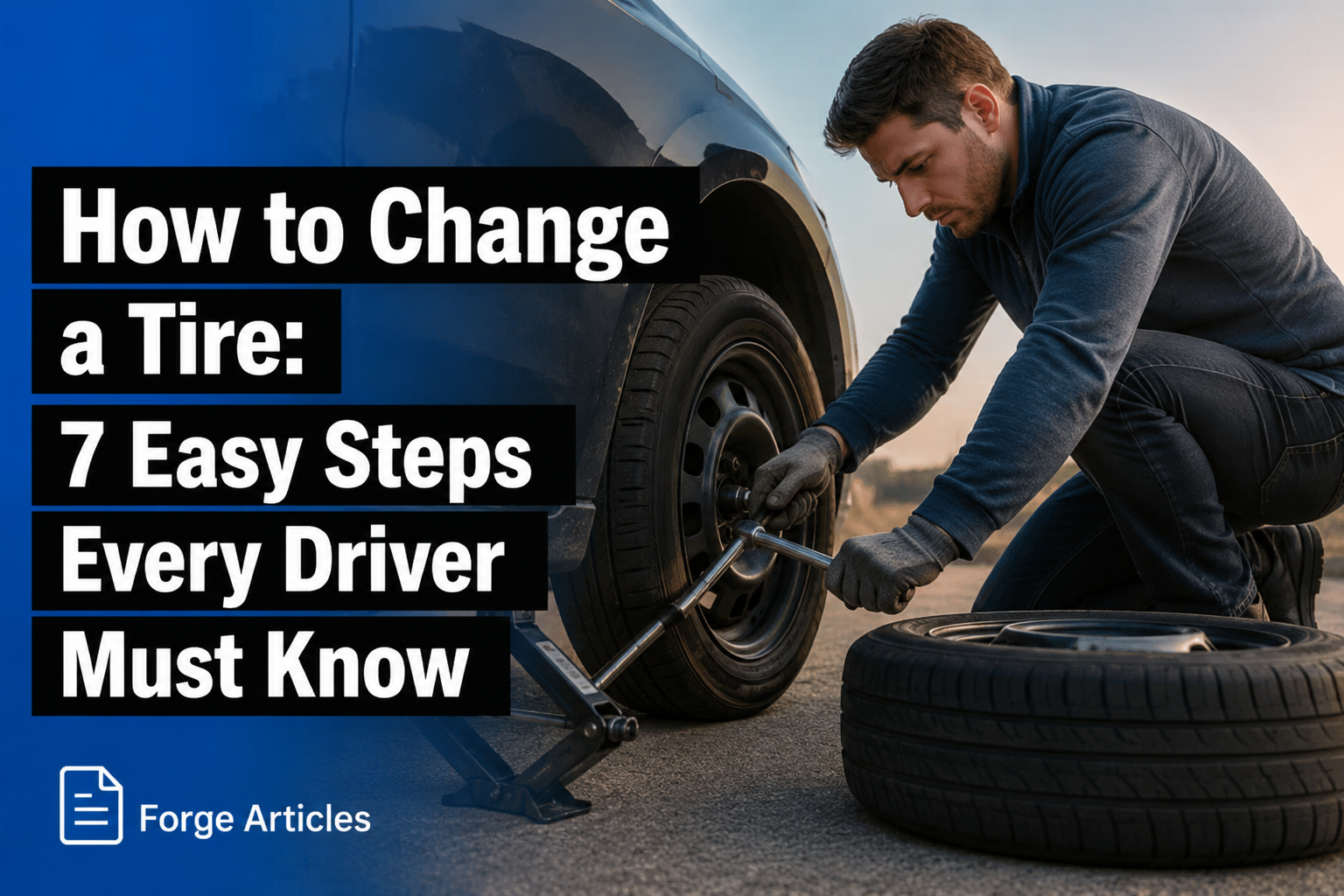
How to Change a Tire? If You Get A Flat: Any driver could get stuck on the roadside with a flat tire, but being prepared to change one can prevent costly delays, high costs, and further danger on the road. Even though roadside assistance is great, millions of drivers do get stuck, and changing it ourselves becomes the quickest solution.
Today’s vehicles are more sophisticated than they have ever been, but the fundamentals of how to change a tire have remained more or less the same. Some of today’s more complex safety technology and electric vehicles and run-flat tire options will alter things a bit, however.
Why Knowing How to Change a Tire Still Matters
Car quality may have gone up in the past 10 years but one of the things that hasn’t is tire blowouts. Left in the road trash, construction sites, pot holes, flat spots or torn up valve stems, tires continue to take you by surprise in a very inconvenient time.
A driver familiar with changing the tire can …
- Reduce roadside waiting time
- Avoid unsafe lifting practices
- Prevent wheel damage
- Improve personal safety in emergency situations
- Minimize repair costs
According to the American Automobile Association (AAA), millions of drivers request roadside assistance every year, with flat tires remaining one of the most common service calls.
Before You Begin: Prioritize Safety
Changing a tyre before it starts.
If your tyre lose its pressure when driving:
- Slow down gradually.
- Avoid sudden braking.
- Keep the steering wheel steady.
- Pull over onto firm, level ground.
- Turn on hazard lights immediately.
Stay in your car and call roadside assistance if the position makes it dangerous in traffic.
The National Highway Traffic Safety Administration (NHTSA) advises drivers to move their vehicle to a safe location away from traffic before attempting to change a flat tire whenever possible.
Tools Required to Change a Tire
The standard equipment for replacing the tire comes standard on most cars. Check for the equipment before you need it.
Standard equipment will have the following items:
- Spare tire
- Vehicle jack
- Lug wrench
- Owner’s manual
- Wheel wedges or chocks
- Flashlight (for nighttime emergencies)
- Reflective safety vest
- Warning triangles
Many of today’s vehicles now no longer have a spare wheel, and instead you’ll find an inflatable system or tire repair kit which you may well only be able to use on a temporary basis.
Step 1: Secure the Vehicle
Once before the car is jacked up :
- Engage the parking brake.
- Shift into Park (automatic) or first gear (manual).
- Place wheel chocks behind the opposite tires.
- Ensure passengers exit safely away from traffic.
Vehicle stability is the most significant factor for the safety of your vehicle at the time of tire replacement.
Step 2: Loosen the Lug Nuts
While the wheel is still on the ground,
Turn each lug nut a little, by turning counterclockwise until you make a half of a turn of the nut.
No, they can’t be removed all of the way!
While the wheel is in place it is hard for it to turn!
Step 3: Position the Jack Correctly
One of the most common reasons for damage to the vehicle when changing a tire on the roadside is improper placement of the jack.
You’ll need to consult your owner’s manual for the location of the lifting point on your vehicle.
Only raise the vehicle high enough to remove the damaged tire.
Improper jack placement or uneven lifting can cause serious vehicle damage and increase the risk of injury during a tire change,” says John Nielsen, former Managing Director of Automotive Engineering at AAA.
Step 4: Remove the Flat Tire
Remove any lug nuts that you already loosened off.
Use both hands and pull the tire straight toward yourself.
Check to see if the wheel hub is:
- Rust buildup
- Damaged wheel studs
- Brake fluid leaks
- Loose suspension components
Visible mechanical damage – It may be prudent to get a mechanic to check over the device before carrying out any further investigation.
Step 5: Install the Spare Tire
Line up wheel holes and wheel studs.
Slide spare tire over the wheel studs as far as it will go.
Place each lug nut into its position by hand until it is finger-tight.
Don’t run each lug nut too tight at first, you will evenly seat them next.
Step 6: Tighten Lug Nuts Using the Star Pattern
Lower the vehicle so the How to Change a Tire barely touches the pavement.
Tighten the lug nuts using a star or criss-cross pattern, distributing force evenly on the wheel.
Tighten them completely once the vehicle is fully on the pavement.
Commercial repair facilities use a calibrated torque wrench to recheck lug nut tightness later.
Step 7: Check Tire Pressure
10 percent of all spare How to Change a Tire don’t hold air; they often can lose air pressure when sitting.
Keep and use tire pressure gauge whenever you can.
If the spare tire is underinflated, your vehicle may lose stability.
Most vehicle manufacturers recommend checking your owner’s manual for the correct How to Change a Tire pressure, as the recommended PSI varies by vehicle model and How to Change a Tire size.
Understanding Different Types of Spare Tires
Not every spare tire offers the same performance.
Full-Size Spare
The Full-Size Spare tyre looks similar to the OEM tyres.
Benefits:
- Normal driving speeds
- Better handling
- Longer usable distance
Temporary “Donut” Spare
How to Change a Tire? These small spare tires are light, but are heavily restricted.
Usually some of these limitations:
- Maximum speed of 50 mph (80 km/h)
- Limited driving distance
- Reduced traction
- Lower load capacity
Always check with the manufacturer.
Tire Repair Kits
How to Change a Tire? Some modern electric and luxury cars are eliminating the spare tire and instead include the above repair kits.
How to Change a Tire? These kits put sealant into a How to Change a Tire that has a minor hole in it, then pump air into the tire.
A tire cannot be fixed using a repair kit if:
- Sidewall damage
- Large punctures
- Torn tires
- Blowouts
Special Considerations for Electric Vehicles
EVs Add to Roadside Repair Issues Many car owners carry a flat tire kit or use roadside service with their electric car when they have a flat, butEVsmake flat repairs more complicatedthan with a gas-powered vehicle. Battery-packs on mostEVsacoccupy a huge areaon the underside of the car, covering a large portion of the floor and making for easy accidental damage to costly battery components if a vehicle isn’t placed correctly with a jack.EV manufacturers typically stress strict compliance with lifting points designated for vehicle servicing and repairs.
Most electric vehicle manufacturers recommend using only the designated jack points outlined in the owner’s manual to avoid damaging the battery pack or underbody components.
Common Mistakes Drivers Make
Despite drivers’ expertise they are able to do silly mistake.
Many mistakes often observed among drivers; some of those are:
- Jacking on soft ground
- Forgetting the parking brake
- Tightening lug nuts unevenly
- Driving too far on a temporary spare
- Ignoring tire pressure
- Standing on the traffic side of the vehicle
Each mistake increases safety risks.
When You Should Not Change a Tire Yourself
Use of this tool should only be in appropriate circumstances.
Do not use to replace a tire in the event that:
- Traffic is moving at highway speeds nearby.
- The vehicle rests on unstable ground.
- Severe weather reduces visibility.
- Multiple tires are damaged.
- The wheel assembly appears bent.
Safety should always outweigh convenience.
Tire Maintenance Can Prevent Future Flats
Routine checks prevent most roadside issues. Most drivers have probably experienced problems on the road, and it is good to check on:
- Tire pressure monthly
- Tread depth
- Sidewall cracks
- Uneven wear patterns
- Valve stem condition
Proper maintenance also improves fuel efficiency and extends How to Change a Tire life.
According to How to Change a Tire industry experts, maintaining the correct tire pressure and inspecting tread wear regularly can improve tire lifespan, fuel efficiency, and overall driving safety.
Broader Industry Trends Shaping Tire Technology
The Auto industry is developing innovative new concepts of Tire designs.
Some of the upcoming ideas are:
- Smart tires with embedded sensors
- Predictive maintenance systems
- AI-powered tire monitoring
- Self-sealing tire technology
- Sustainable recycled rubber compounds
The goal is to minimize breakdowns while at the same time enhancing road safety and environmental responsibility.
Expert Perspective
Experts in Automotive safety remind us, “Better to prepare than to repair”.
“The best time to learn how to change a tire is before an emergency happens. Preparation and basic roadside knowledge can make a significant difference in driver safety,” automotive safety experts emphasize.
It may be more practical to simply use vehicle equipment prior to a real emergency than it would be to look up the directions in the book.
Frequently Asked Questions
How long does it take to change a tire?
Driving under safe conditions would typically take 20-40 minutes to swap a How to Change a Tire out.
Can I drive on a spare tire for several days?
If the manufacturer allows you to. Temporary spare tyres are designed for temporary use only to get to your mechanic.
Should lug nuts be rechecked later?
Yes, in fact, some manufacturers suggest checking the tightness of your lug nuts after about 50-100 miles of driving.
Is it safe to How to Change a Tire on the highway shoulder?
Only do this if there’s plenty of room between your vehicle and other traffic. If not, call roadside assistance.
Conclusion
Even with modern automobile advances, being knowledgeable of how to properly change a Tire is a skill that has and will always remain critical for any motorist. When it is done properly, changing a flat How to Change a Tire can be a relatively simple task. Each part of the procedure – from selecting a safe location on the roadside to tightening wheel lugs in the proper order – has a significant bearing on the safety of the individual responsible.
While the driving experiences that are associated with interconnected vehicles and electronic transmissions are steadily shifting towards what is possible for the intelligent tires, basic roadside procedures haven’t changed.
With routine How to Change a Tire maintenance coupled with a modicum of mechanical expertise, motorists will be able to face tire failures with confidence while being capable of minimizing exposure while sharing our road space.
