


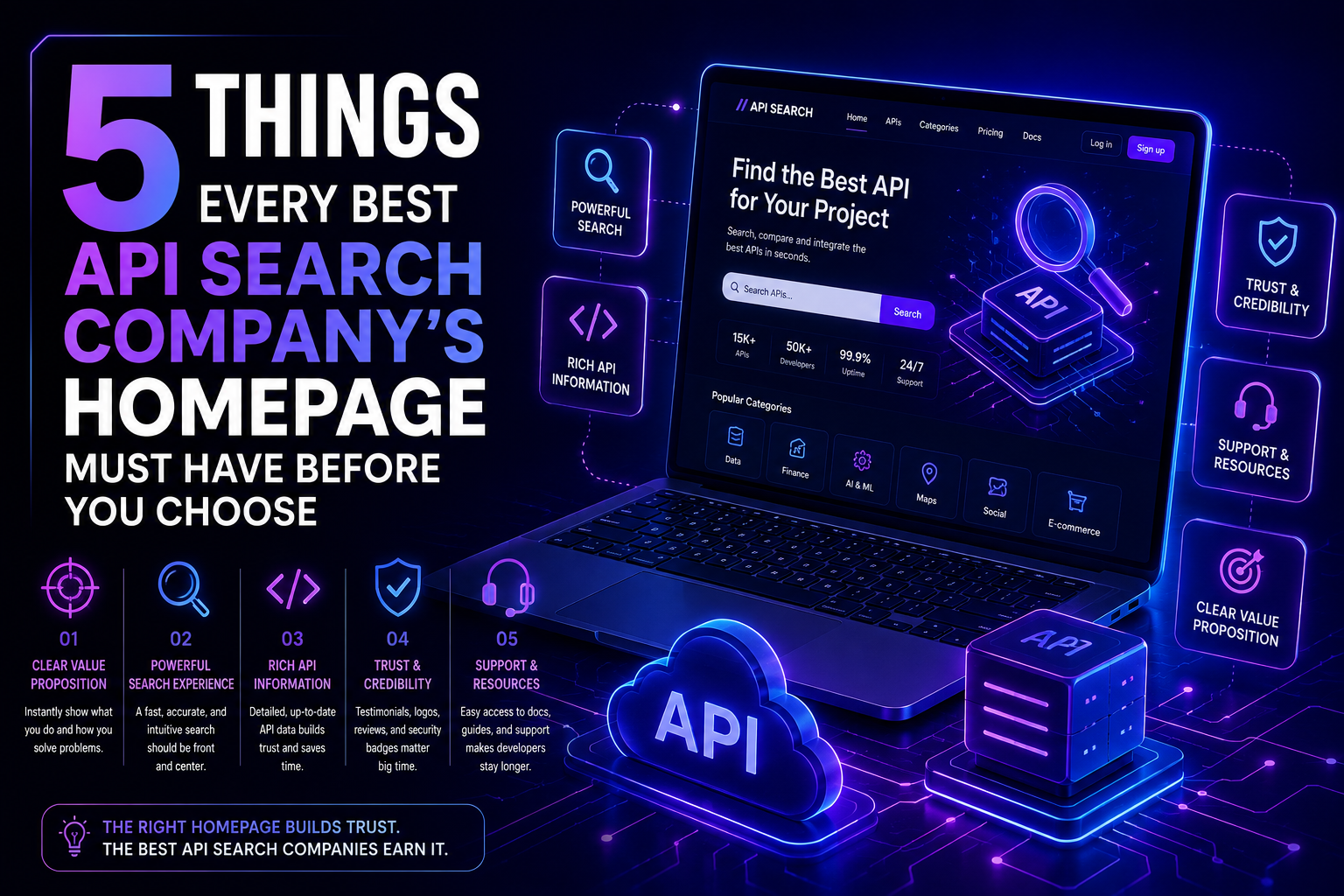
How to Find the Homepage of the Best API Search Company’s Homepage. Don’t just grab the first thing from a Google search. For businesses, entrepreneurs, developers, or someone creating an AI app, the API provider’s homepage will probably be your first interaction. The user needs to be able to ascertain what the product does, how it works, what it costs, and if it’s the right solution for your app, very rapidly. Considering the huge number of API search companies on the market today, let’s get started and explore which ones you need to keep an eye on.
What Is an API Search Company?
An API search company sells tools that will enable applications to send and retrieve information programmatically via search. The search API tool basically substitutes for having to build entire search infrastructure that’s needed by your application or website. Depending on the API search provider, they enable applications to search for either data from general web content, specific sites, or established databases and data feeds.
For example, an AI application may use a search API to retrieve current web information before generating an answer. An SEO platform might use one to collect search results, while an e-commerce application could use an API to find products.
What Should a Good API Search Homepage Include?
A provider’s homepage should make important information easy to find. Don’t try to make users waste an hour scrolling page after page trying to find what the API is really for.
Read it through and see that, at the very least is includes the following:
| Homepage Element | Why It Matters |
| Clear API description | Helps you understand the service quickly |
| Documentation link | Shows how integration works |
| Pricing information | Helps estimate your potential costs |
| API examples | Demonstrates practical usage |
| Supported features | Lets you compare capabilities |
| Developer resources | Makes implementation easier |
| Support information | Useful when technical problems occur |
A polished homepage is helpful, but it should be supported by detailed documentation and transparent technical information.
API Documentation Is One of the Biggest Factors
The developer experience can also make or break an API’s success. No matter how rich an API can be, it won’t be used if the developer who wants to integrate the API with their applications isn’t clear on what can be done with the given API. Check for the best documentations include an explanation of authentication, endpoints, input parameters, output schemas, status codes, and other usage limitations.
Especially, code samples demonstrating the usage of the API are helpful in real applications.
There may be support for various programming languages such as Python, JavaScript, Java, and GO.
Before choosing a provider, try following its basic integration guide. If you can understand the process without constantly searching for outside explanations, that is generally a good sign.
Search Quality and Available Features
Not every search API works in the same way. Some focus on general web search, while others are designed around search engine results, websites, documents, or specialized datasets.
Consider what your application actually needs.
Some potentially useful features include:
- Web search
- News search
- Image search
- Geographic filtering
- Language filtering
- Domain restrictions
- Pagination
- Safe-search controls
- Structured responses
- Real-time results
The Best API Search Company’s Homepage should clearly explain which features are available rather than relying entirely on vague marketing statements.
Pricing: Look Beyond the Advertised Number
Cost is also a significant factor when comparing API providers. Since businesses differ in their billing methods, relying solely on a monthly base price can be deceptive.
| Pricing Model | Best For | What to Consider |
| Pay per request | Variable usage | Cost can increase with traffic |
| Monthly subscription | Predictable usage | Check included request limits |
| Credit-based | Flexible projects | Understand credit consumption |
| Enterprise | Large applications | Usually requires custom pricing |
Check whether the provider charges for successful requests, all requests, additional features, or excess usage. Rate limits and overage fees should also be clearly explained.
A free tier might be helpful with testing; however, you should at least be allowed enough features to be able to properly test out the API.
Speed and Reliability Matter
Search functionality is an easy function that can be utilized directly within the application, so slow answers will directly hinder the user experience.
When choosing a provider, you should look for response time values, availability and uptime, how much is the rate limit, and the availability of the service.
Certain companies put up a status page where developers can see past incidents and be able to monitor ongoing ones.
Don’t go solely by advertised speed figures. Search can be affected by the type of search, location, speed of the network, and technical limitations.
I would try the API on my own before relying upon it for an essential system.
Comparing Popular API Search Providers
The best providers don’t really exist-they’re optimized for specific uses. Comparing directly will help reduce your choices:
| Provider Type | Main Strength | Suitable For |
| Web search API | Online search results | AI apps and research tools |
| SERP API | Search engine result data | SEO and rank tracking |
| Scraping API | Website data extraction | Data collection |
| AI search API | Search combined with AI workflows | AI applications |
| Enterprise search API | Large-scale infrastructure | Business platforms |
Rather than asking which provider is ‘best’, identify which best fits your need. If you’re developing an SEO tool, you’ll want lots of search-engine-based data. On the other hand, an AI app will crave lots of up-to-the-minute data from the web, in a clear structure that has lots of meaning for an algorithm.
How to Evaluate an API Before Paying
As the world’s first and arguably only API testing company, the absolute smart way to go is to ‘try before you buy ‘.
Take an API out for a test spin, kick off a little project and see how you can get set up, authenticate, fire off a request, parse the result and deal with any error conditions. Also, and perhaps crucially, test not with a single passing result, but with a few different query inputs.
During testing, pay attention to:
- Response consistency: Do similar searches produce reliable results?
- Latency: Does the response arrive quickly enough for your application?
- Documentation: Can you solve basic problems using the available guides?
- Limits: Are request and rate limits suitable for your expected usage?
- Pricing: Does the cost remain reasonable as usage grows?
In many cases, that sort of practical testing tells more than the company’s homepage.
The Homepage Still Has a Role to Play
While it’s only a surface-level presentation of the API, the homepage tells you a bit about how seriously a company takes transparency and the developer experience.
A good homepage should answer these questions concisely: What does the API do? Who is it for? How do I get started? Where is the documentation? How much does it cost?
If it’s difficult to answer these basics, then chances are you’ll want to do a little more research before jumping in.
Conclusion
Finding the best API Search Company’s homepage is just the beginning. You won’t trade adequate performance, robust search results, good documentation, and a suitable fee for a slick-looking UI. Eventually, the best API depends on how badly you need a certain query to be found, for what amount of money, and within which limits, so check and compare every provider and evaluate your best bet on the basis of the API and its documentation.
FAQs
Q: What is an API search company?
A: An API search company is a business that provides an API to other developers that use that access point to conduct search queries on any provided database (like: business listing api, Product search api, web search engine,…)
Q: How do I find the best api search company homepage?
A: The Best API Search Company’s Homepage will first need to address the needs of its customers. You first need to know what are the searches you need, and only after that do you need to visit every one to find the “best fit”.
Q: Do the free search APIs have the same quality as the paid search APIs?
A: Typically not. Most free APIs are designed for small developers to try and use for free,e but with a limited number of searches and rate limiting. Professional and commercial products may offer enhanced speed and more features from their search APIs.
Q: What is a search engine?
A: A search engine is a program designed to assist in finding information stored on a computer system or in a database using techniques such as keyword searching.
Q: How do I use an API?
A: Using an API requires basic computer and programming skills. You’ll have to study the API documentation on its official website before implementing it in your own code. Depending on your chosen tool (i.e., different programming languages), you can make HTTP requests to the API’s endpoints.
