


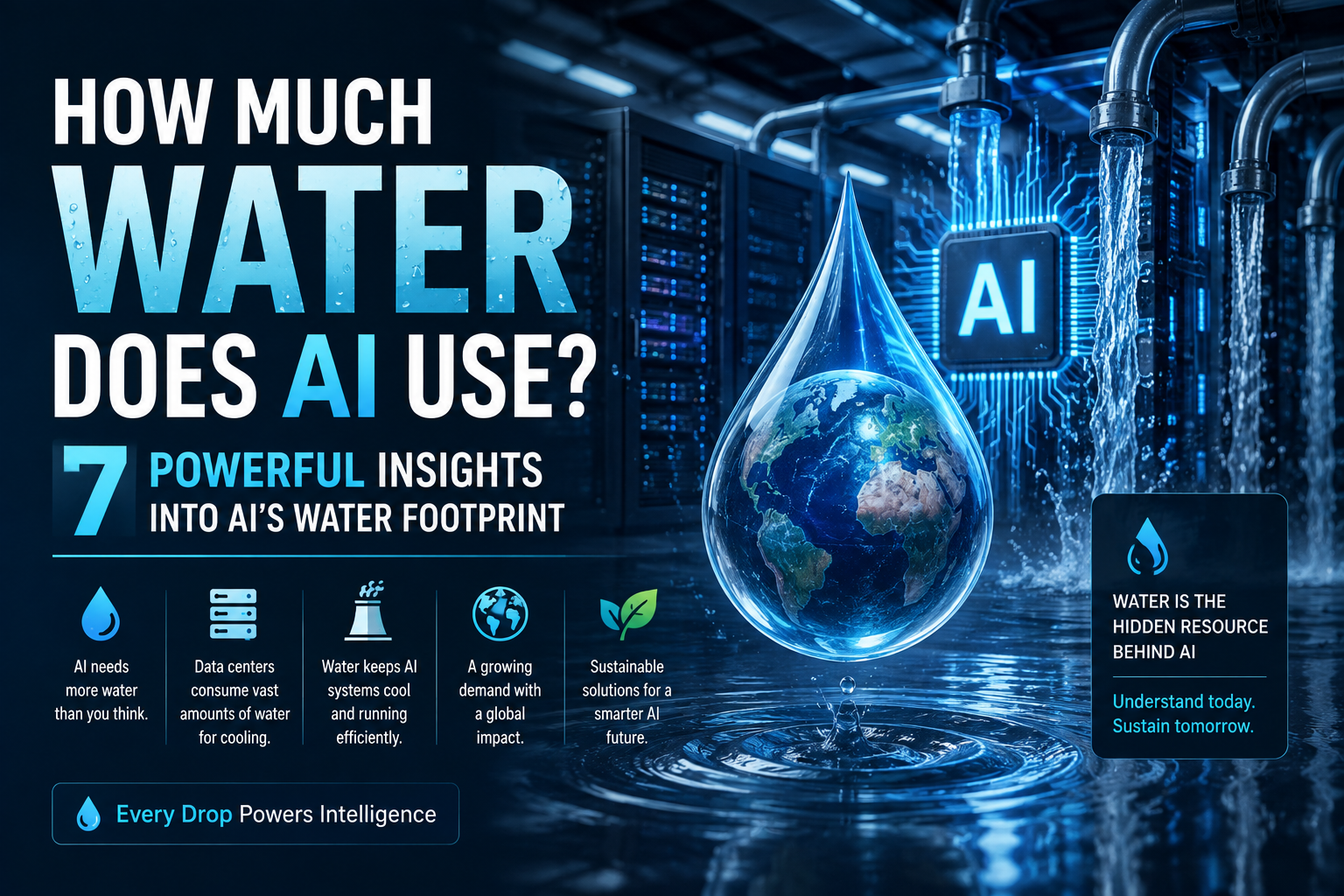
Artificial intelligence is the basis of modern technologies such as chatbots, image creators, search engines, recommendation systems on any websites, and many other conveniences. However, despite all the amazing possibilities and opportunities that this technology provides, its popularity and aggressive development have led to some problems, such as energy and water resource consumption. The latter issue currently attracts great interest. How much does AI consume? In particular, how much water does ai use consume?
However, it is not that simple since various AI applications indirectly consume water. The technology itself does not require how much water does ai use to process data or provide users with answers when they type a query into the search engine. The consumption of freshwater sources is associated with providing electricity to data centers and other facilities involved in the development and training of AI models.
Why Does AI Need Water?
In order to find out how much water AI consumes, it is essential to evaluate the functioning principle of data centers. Since AI requires advanced models which are supported by powerful servers endowed with specific processors, it is possible to state that these machines are energy-intensive and produce substantial amounts of waste heat.
Due to the specific nature of data centers, their cooling systems play a critical role in maintaining stable temperatures and avoiding overheating. In this regard, the water consumption of AI depends on the infrastructure of data centers since they are often cooled down with the help of cooling towers. At the same time, water may be involved in the electricity generation process depending on the energy source, due to which the water footprint of AI can be even higher.
How Much Water Does One AI Query Use?
One of the most common questions is – how much does AI drink for one use? Unfortunately, there is no simple answer to this query. The amount of how much water does ai use needed for use by artificial intelligence depends on several factors.
The list includes the type of used AI, the region in which it is located, the cooling system of the data center, the climate, the source of electricity, the efficiency of the equipment, and even the specific task. Thus, the amount of water needed in the case of a simple text request and a complex image recognition task will differ significantly.
Some studies have tried to quantify the amount of water consumed by various AI procedures. However, these numbers should be used with caution since they represent averages rather than specific values for each case.
Training AI Models Can Require More Resources
AI models are usually trained intensively before they are deployed to answer users’ queries. Such training can take thousands of powerful processors working for an extended period of time.
Therefore, when analyzing how much water does ai use consumption, one should distinguish between training models and using them for inference, or computing an answer.
The training process itself can be computationally intensive, thereby requiring massive amounts of water for cooling depending on the model’s size, the training duration, the processors used, data center’s performance, and the location of these data centers.
Nevertheless, even once a model is trained, its inference still involves heavy computations since millions of queries need to be addressed. Consequently, the how much water does ai use printing depends not only on the model itself but also on the amount of queries it has to process.
Location Makes a Difference
Another vital issue that should be considered in determining how much water does AI use is the location of the data centers.
For example, a data center located in a hot desert will use much more water for cooling than a data center in a temperate zone. Data centers that use closed-loop cooling systems will also have a significantly lower water footprint than those that rely on evaporative air cooling methods.
In addition, the source of electricity is also essential, as power production often requires water for cooling purposes. Therefore, two data centers located in different geographical areas and using different electricity sources may have completely different water footprints even if they use similar AI solutions.
Why AI’s Water Footprint Matters
The question of how much water does ai use is important because water is a limited resource in many areas. Data centers may use water in ways that compete with other local needs, such as agriculture or residential needs.
This does not mean that AI is responsible for the majority of how much water does ai use consumption in a particular area or that it is inherently wasteful. Rather, it is necessary to consider the potential effects of large-scale computer technologies on the local environment where they are being deployed.
The adoption of AI by many entities could lead to billions of separate transactions, which would put a substantial strain on natural resources even if each transaction involved only a minimal amount of water.
Can AI Become More Water Efficient?
Technology companies and data-center operators are working on a number of approaches that would make computers less environmentally damaging than today’s supercomputers and servers. The methods include developing more efficient processors, using innovative techniques to cool data centers, harnessing renewable energy, maximizing the use of servers, and recyling water.
Moreover, it can be noted that AI itself could contribute to this endeavor. For example, there is potential for using machine learning algorithms to help manage, cool and maintain data centers more efficiently.
Finally, enhancing efficiency is critical because it could become progressively more challenging to meet demand with the boom in artificial intelligence and advanced technologies.
The Bigger Picture
Thus, how much water does ai use consume? Unfortunately, there is no standard measure that can apply to all artificial intelligence and prompts. There are too many variables that can affect the amount of how much water does ai use. The energy used to cool data centers, the method of electricity production, efficiency, scale, and even the location of an AI can determine its water usage.
How much water does ai use: Instead, we should focus on the entire AI infrastructure, including data centers, electricity, training models, and serving, rather than a single prompt and its water footprint.
Final Thoughts
AI has great potential, but knowing how impactful it is on the environment is an essential component of being a responsible user. Knowing how much water does ai use makes you more aware of an element you might not have thought about in relation to technology.
As AI becomes more sophisticated and data centers find better ways to cool their equipment, there are benefits to both those using the technology and those selling it. Users of these products need to look at the production behind what they buy in order to make an educated choice.
