


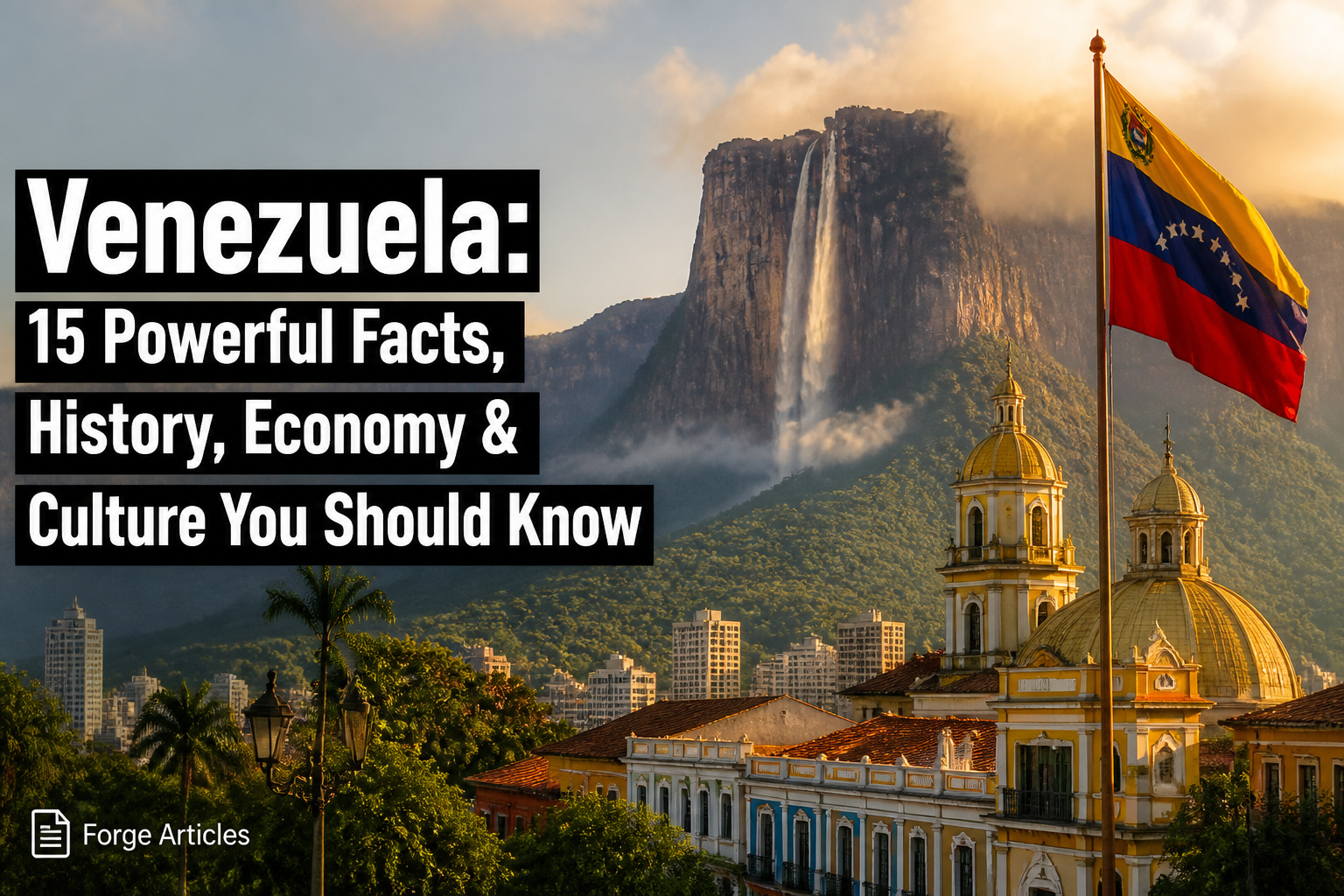
Most talked-about country in South America, Venezuela is world-renowned for the natural beauty that can be found across the nation, its extensive oil reserves, its culture, and its economic history.
What could be more to know?
He is also known as the country with the world’s highest waterfall and the Caribbean coast.
It’s popular amongst travelers, academics, college students, as well as international media sources.
While it has often hit headlines for economic troubles of recent years, it’s truly far more than just news. It has incredible biodiversity, lively cultural traditions, friendly natives and neighbors, and significant influence on the energy economy worldwide. Whether you’re studying South America, getting ready for a trip, or are just curious, we break down all that you should know about Venezuela in clear and simple terms.
Where Is Venezuela Located?
It is located on the north coast of South America. It is well positioned as it has access to the Caribbean Sea, which serves as a gateway between the region and South America.
Venezuela borders:
- Colombia (west)
- Brazil (south)
- Guyana (east)
- Caribbean Sea (north)
Its geography has impacted its economy, its trade routes, the development of its tourist trade, and its people and cultures.
Quick Facts About Venezuela
| Information | Details |
| Official Name | Bolivarian Republic of Venezuela |
| Continent | South America |
| Capital City | Caracas |
| Official Language | Spanish |
| Currency | Venezuelan Bolívar |
| Population | More than 28 million people |
| Time Zone | Venezuela Time (VET) |
These facts contribute to Venezuela becoming a globally recognised Latin American country.
Why Is Venezuela Famous?
Many have asked me what’s happening to he that the news media are always talking about it? The explanation is much more than just politics.
This country is known for the following, among others:
- The world’s largest proven oil reserves
- Angel Falls, the world’s tallest uninterrupted waterfall
- Beautiful Caribbean beaches
- Rich wildlife and national parks
- Diverse landscapes
- Historic independence movement
- Colorful festivals and traditions
- Delicious Latin American cuisine
All of those attractions have a direct effect on the worldwide perception of Venezuela.
A Brief History of Venezuela
The story can be dated thousands of years before Europeans landed on this land.
Native cultures occupied the territory many centuries before the Spaniards came in the sixteenth century.
It was among the front lines in South America as a battleground during the revolution against Spain at the beginning of the 1800’s.
In this struggle for independence, one of the main protagonists was Simón Bolívar, who is the Liberator of it and four other South American countries.
The period after independence saw many different changes that marked the current country.
Geography That Makes Venezuela Unique
One of the most striking things about it is the breathtaking variety in its geography.
Visitors can take part in:
Snow-Capped Mountains
The Andes mountain range enters western Venezuela, offering breathtaking landscapes and a pleasant climate.
Tropical Rainforests
Most of southern he consists of deep jungle, filled with uncommon wildlife and plant species from the Amazon rainforest.
Caribbean Coastline
Nice beaches, islands, and coral reefs along the Northern coast. Very beautiful blue sea can be the destination for a wide variety of travelers.
Vast Plains
Grassland of the Llanos, famous for animals such as capybaras, crocodiles, anacondas, and many species of birds.
All of the above landscapes contribute to the fact that Venezuela is one of the most biologically diverse countries on earth.
Angel Falls: Venezuela’s Greatest Natural Wonder
Nobody talks about it without mentioning Angel Falls. Situated within the vast Canaima National Park, this majestic cascade drops from the side of Auyan-Tepui, towering at a height of 979 meters (3,212 ft), which stands as the world’s highest uninterrupted waterfall.
The breathtaking site, framed by imposing cliffs, virgin forests, and unadulterated nature, attracts travellers from all over the planet, transforming this waterfall into a global symbol of its stunning nature.
The Economy of Venezuela
Over the past decades, the country’s economy has undergone significant transformations.
In the past, it grew into one of the major oil-producing countries in the world; its crude oil sales contributed largely to the country’s revenue and economic growth.
Today, due to price fluctuations, inflation, economic policies, sanctions from other countries, and a decrease in oil production, it faces some economic obstacles.
Presently, the country is trying to regain economic stability and looking to opportunities in the following economic fields:
- Agriculture
- Tourism
- Manufacturing
- Mining
- Technology
- Renewable energy
Economic reform remains an essential concern for policymakers and international commentators alike.
Natural Resources in Venezuela
One of the biggest assets is the richness of natural resources.
The country has:
- Massive crude oil reserves
- Natural gas
- Iron ore
- Gold
- Diamonds
- Bauxite
- Hydroelectric potential
These significant resources have turned Venezuela into a globally vital energy-producing country.
Culture and Traditions of Venezuela
Its culture: The culture is indigenous to Venezuelan natives and includes African and European influences.
Culture of he: family culture and music as a his tradition. Its Culture; family culture; its-music – Her family; Its Music; he family.
Folklore: Popular elements of the Culture; its culture; its Popular Music.
- Traditional folk music
- Colorful festivals
- Local handicrafts
- Warm hospitality
- Regional cuisine
- Religious celebrations
The traditional aspects help protect the character of the nation, and it has helped draw tourists from outside.
Tourism in Venezuela
Despite many of the difficulties, it is one of South America’s most naturally stunning locations.
With its combination of stunning beaches, majestic mountains, vast rainforests, and amazing wildlife, there is something here for the most enthusiastic eco-adventurer or nature enthusiast.
Several popular sites include:
- Angel Falls
- Canaima National Park
- Los Roques Archipelago
- Mount Roraima
- Morrocoy National Park
- Mérida Cable Car
- Orinoco River
“It goes to show how much diversity there is within Venez, and that’s something a lot of people don’t know,” one of the travelers added.
Wildlife and Biodiversity
World Class Biodiversification it ranks as one of the world’s best countries in terms of biodiversity. The natural beauty includes thousands of plant species and numerous kinds of wild animals that can only be seen in it, such as:
- Jaguars
- Giant anteaters
- Capybaras
- Giant river otters
- Scarlet macaws
- Toucans
- Pink river dolphins
- Howler monkeys
- Sea turtles
The presence of protected national parks will assist in preserving such fantastic animals for the benefit of future generations.
Politics and Current Situation
His politics has become a topic of discussion worldwide for years. From leaders, economy, international affairs, and elections, it has witnessed several significant transformations.
Along with other countries around the world, Venezuela still faces certain opportunities and challenges.
- Economic recovery
- Inflation management
- Infrastructure development
- Public services
- International cooperation
- Investment opportunities
While it moves to achieve long-term security and development, governments, organizations, and companies around the world are closely observing events.
Education and Healthcare
Education continues to play a key role in its national development. The country boasts public and private universities educating citizens in the fields of medicine, engineering, sciences, law, and business.
Health care services can be accessed nationwide, although the field has struggled in recent years due to issues with funding, infrastructure, and medical supplies.
Education and health care will both remain crucial for the country to continue its progress.
Is Venezuela Safe for Travelers?
A very common concern about visiting Venezuela is safety. However, as long as you do your homework about your destination, prepare yourself well, and follow common sense precautions, traveling to it is just as safe as traveling to any other country.
Visitors should also:
- Check official government travel advisories.
- Follow local laws and customs.
- Use trusted transportation services.
- Avoid unfamiliar areas at night.
- Keep valuables secure.
- Purchase comprehensive travel insurance.
With adequate preparations and reliable help from some locals, the tourists managed to visit many spots and attractions in chosen areas.
Interesting Facts About Venezuela
Here is a he Interesting Fact, which may not be commonly known:
1. Home to the World’s Tallest Waterfall
Angel Falls is the world’s tallest uninterpreted waterfall.
2. One of the Largest Oil Producers
He is the nation with the greatest proved crude oil reserves on the planet.
3. Incredible Biodiversity
Deserts, beaches, rainforests, mountains and wetlands are to be found within the country’s borders.
4. Caribbean Coastline
Numerous islands and exquisite beaches form the northern coastline.
5. Rich Cultural Heritage
As the old music, dance, festivals, and traditional cuisine. It is still an important part of it culture.
6. Mount Roraima Inspired Literature
Many believe that the peculiar look of the famous mountain prompted the tales of adventure that were told about the island.
7. A Country of Natural Wonders
In terms of beauty and biodiversity, there’s nowhere on Earth that’s really comparable to this, in all of the country. It has more diverse regions than any other country on Earth, ranging from the vast Amazon rainforest to the majestic Andean Mountains, all within its borders.
Why Venezuela Matters Globally
Beyond South America, It plays other key roles:
- Global energy markets
- Environmental conservation
- International trade
- Biodiversity protection
- Regional diplomacy
- Tourism potential
- Cultural influence
Even though the country is still developing, it will certainly still play an important role for economists, the environment, tourists, companies, and those who govern the world.
Frequently Asked Questions
Where is Venezuela located?
He occupies the north coast of the continent of South America and has its boundaries with Colombia, Brazil, Guyana, and the Caribbean Sea.
What is Venezuela famous for?
Venezuela, or Bolivia as it is commonly known, is celebrated for its world’s largest oil reserves, its Caribbean beaches, its biodiversity, the spectacular falls that give the country its name, and of course its colourful and varied culture.
What language is spoken in Venezuela?
The official language is Spanish.
What is the capital of Venezuela?
Caracas is the capital and largest city.
Is Venezuela good for tourism?
Yes, It is very much natural wonders, national parks, mountain ranges, waterfalls, and also beaches; so travelers must verify all present advice before coming.
What currency does Venezuela use?
Its official currency is the Venezuelan bolivar.
Conclusion
Venezuela, despite current challenges and perceptions driven by recent economic and political changes, is a land of striking contrasts, boasting spectacular natural scenery, a wealth of natural resources, a colorful history, and a lively culture.
It is a nation that continues to captivate with such incredible natural treasures as the angelic waterfalls, the warm Venezuelan coast, and extensive national parks.
A closer examination of this past, present, and potential can offer a fascinating view of a nation that has a remarkable number of interesting historical, cultural, and natural wonders for geography students and world travelers alike.
